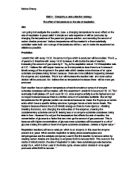
Enzymes work up to their optimum temperature proportionally to the rate of reaction. Increase in temperature increases the kinetic energy of the particles which causes them to move faster and faster. If they begin to go too fast, atoms begin to vibrate too vigorously and the chemical begins to break down. When this happens the shape of the enzyme is altered and it is said to be denatured, and an enzyme cannot repair itself after it is denatured. When the temperature goes very low, the kinetic of the particles is very low too, and the particles mostly do not have enough kinetic energy to overcome the activation energy barrier, so the rate of reaction should be very low at this temperature. Therefore substrate concentration highly affects the rate of reaction.
Prediction
My prediction is brought on by the fact that respiration involves many enzyme-controlled pathways. The kinetic energy of the particles increase as the temperature increases, which means that the temperature should constantly increase the rate of respiration. But if the temperature get’s too high, the enzymes may become denatured. If the enzymes are denatured, then the respiration should slowly come to a halt. This theory can be proven using an experiment, because enzymes are involved in some of the biological pathways for respiration. Some of the main enzymes are dehydrogenase enzymes and decarboxylase enzymes, the dehydrogenase enzymes take hydrogen and pass them onto NAD molecules, or simply let them stay in the matrix, and wait to be bonded with an oxygen molecule. Another important enzyme is ATP synthetase, which synthesises ATP from ADP
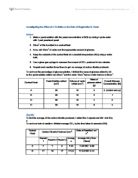
Methylene Blue
Yeast suspension
Water
Thermostatically Water Bath
Kettle
5 test tubes
5 bungs
Test tube rack
0-10 cm³ syringe
100 cm³ beaker and 200cm ³ beaker.
Analogue stop clock
My graph shows that as the temperature increases, the time taken for the yeast to return to original colour also decreases. This clearly shows that as the temperature increases the rate of respiration also increases. But after 40ºC the rate of respiration does not increases as much as before 40ºC. Also, after 45ºC the rate of respiration gets slower still. I can now conclude that as temperature increases, the kinetic energy of the particles increases, which in turn increases the rate of reaction until optimum temperature, is reached. Once the optimum temperature has been reached, the enzymes begin to denature and the rate of respiration slows down. This proves that my scientific theory and prediction were actually correct. I would have used percentage differences but they would have confused the results table and graph. This is because with higher numbers there will not be much of a percentage difference even if the actual difference is great, but if you were given lower numbers with an equal difference, the percentage difference would be still be higher. This will confuse my results and provide an unclear analysis of them; therefore I will not use percentage differences My scientific knowledge backs up my results entirely. The kinetic energy of the particles increased as the temperature was raised, which cause the rate of respiration to increase substantially. But as the temperature got higher than the optimum temperature for the enzymes, the rate of respiration decreased. This was because the kinetic of the particles was increased they started to vibrate vigorously and the enzymes were slowly denatured. So if the yeast was left in the temperature for longer more enzymes would have denatured, causing the rate of respiration to decrease even more. From 35˚C – 40˚C the rate of respiration is fairly fast, and is the steepest slope in the entire graph. This proves my theory that the optimum temperature for most enzymes is 37˚C. From 40˚C - 45˚C the rate of respiration decreases, but only a slight decrease is noticeable. But in my theory it is written that at this point the enzymes should be denaturing. I still believe my theory to be true, because I believe that the enzymes were not given enough time to denature fully. From 45˚C and onwards there is quite a clear decrease in the intensity of the slope of the graph, this is because the temperature is high enough so that the kinetic energy of the particles is large enough for the enzymes to denature quite quickly. I was required to how the temperature affects the rate of respiration in yeast. I can conclude that as the temperature increases, the rate of respiration increases due to the faster motion of the particles. But after the optimum temperature of between 35ºC – 40ºC is reached, the enzymes will slowly begin to denature and the rate of respiration will decrease from there onwards. It will take longer and longer for the methylene blue indicator to disappear. Anomalous result means that a result is totally wrong and doesn’t fit into any pattern whatsoever.
I experienced two anomalous results altogether, both were in my third repetition. Both anomolous were suspiciously the final repetitions of my experiment. The anomalous results could have been for a number of different reasons. The first anomaly, which occurred in the second to last temperature, had a higher rate of respiration than the other two repetitions; the rate of respiration for the anomaly was 90 seconds, whereas the average of the other two was 124.5 seconds. The last anomaly occurred on the final temperature, this rate of respiration was also far greater than the other two; the rate of respiration for the anomaly was 83 seconds, but the average rate of respiration was 106.5 seconds..
I could have experienced these anomalies for a variety of reasons. The reasons are the limitations that I was stuck with, and other sources of error. The main source of error would be human error involved with reading the apparatus, and measuring. When drawing the required amount of yeast suspension, I decided to take 5cm³ because this was adequate. The syringe was accurate, but when I looked at it, I may have made small error in calculating the exact measurement of the syringe, the actually volume taken may have been slightly higher than 5cm³. Also, when I checked the thermometer, to check that the required temperature was what it read; my eye-level was sometimes not level with the meniscus, this could have given an anomalous result. These two sources of error could have easily been responsible for the anomalous results I gained. The temperature of the surroundings may not have been the same on the two days, or even on one single day they may have fluctuated. Other fluctuations of temperature of the water baths did occur. This was a major drawback. The thermostatically controlled water bath did a good job in maintaining the temperature, but the temperature did rise and fall about 1˚C or so once in while. But when I manually measured the temperature, there were much more major fluctuations in temperature. When adding water from a kettle, the temperature rose alarmingly fast, so I had to add tap water to cool it down, this sometimes cooled it too much. Other than this, when I did find the wanted temperature, the temperature would fall again and I would have to add water from the kettle to warm it up, which would lead to the same routine of it getting to hot. This could have given me unreliable results. When adjusting the temperature I also found myself looking away from the methylene blue and yeast suspension, in some cases, when I looked back at the suspension, it had already returned to its original colour. This would have given me some anomolous results, especially for the lower temperatures, which ran for a longer period of time, and so required more work to be done to maintain the temperature. Variations in the total time that the methylene blue and the yeast were left to react, and the time taken for me to adjust the apparatus and start and stop the stop clock. Also another source of error would be the analogue stop-clock I was using, at some points it got slightly tricky to use and, sometimes, seconds could have been counted for the time it took me to adjust it. These variations in time were mostly due to human error. I started the timer after I added the yeast, placed the bung and inverted the test tube twice and then replaced the bung, I could have missed crucial seconds in my results due to this flaw. This could have given unreliable results, but if done the same way every time, the results would not contain anomalies. I mean ‘the same way’ as saying that starting the timer after the bung is removed, and not before. This could have been the reason for my anomalous results because the particles may have gained extra kinetic energy and respired faster. The yeast suspension may have not been evenly distributed in the test tube. I did invert the test tube to ensure that, initially the yeast suspension didn’t stay settled at the bottom of the test tube and the methylene blue didn’t remain above. This allowed the two to mix properly and be evenly distributed throughout. But eventually I believe that the yeast may have begun to settle down again. If the yeast did eventually settle that would mean that it would take even longer for the yeast to return to its original colour. This would provide unreliable results. But I do not believe this gave me my anomalous results, as my anomalous results were faster than they should have been. If the yeast did settle then the rate of respiration would have been less, resulting in a slower time. A liable reason for my results being anomalous would be the way I inverted the test tube. As I may have put more effort into inverting one test tube than another, and one mixture may have gained more kinetic energy, so the rate of respiration would increase. This could have caused my anomalous results to come about. Adding methylene blue had to be done carefully so I didn’t accidentally add more than 3 drops, this was done accurately by me, so it could not have been a source of error. But the volume of the drops probably always varied from drop to drop. If three small drops were put into a yeast suspension which had more yeast suspension in it by human error, the methylene blue indicator would disappear much faster. This source of error could have been another reason for my anomalous results. Over the two days there was a variety of methylene blue bottles available to me. If I used two different bottles over the two days, the concentrations could be varied, due to contamination or dilution. This would have seriously affected my results, and could have led to my anomalous results. Other small things could have affected the results and could have caused anomalies. The syringe may not be entirely clean for every repetition, because it is used over about 15 times. I could not clean it with water, or else water may contaminate it, causing the yeast suspension to become slightly dilute on some occasions. There was a small amount of methylene blue remaining on top of the solution. This methylene blue was reacting with the oxygen in the air. The temperature in the water bath may not have been entirely uniformly distributed, due to little mixing. Accuracy of resultsc