Reflecting telescopes
Reflecting telescopes use mirrors instead of using lenses.
The reflector is simple and inexpensive to make. Large aperture primary mirrors (greater than 10 inches or 25 centimetres) can be made easily, which means that reflectors have a relatively low cost per unit of aperture. Reflectors have large light gathering capacities, and can produce bright images of faint, deep-sky objects for visual observing as well as astrophotography. One disadvantage of reflectors is that you occasionally have to clean and align the mirrors. Also, slight errors in grinding the mirrors can distort the image. Here are some of the common problems:
- Spherical aberration - light reflected from the mirror's edge gets focused to a slightly different point than light reflected from the centre.
- Astigmatism - the mirror is not ground symmetrically about its centre (it might be slightly egg-shaped, for example); star images focus to crosses rather than to points.
- Coma - stars near the edge of the field look elongated, like comets, while those in the centre are sharp points of light.
In addition, all reflectors are subject to some light loss, for two reasons: First, the secondary mirror obstructs some of the light coming into the telescope; second, no reflective coating for a mirror returns 100 percent of the light striking it -- the best coatings return 90 percent of incoming light.
The main difference between a refracting telescope and a reflecting telescope is that refracting telescopes use lenses and reflecting telescopes use mirrors.
A telescope has two main properties
- How well they can collect the light
-
How much they can magnify the image
How well a telescope collects the light is directly related to the diameter of the lens or mirror. This is known as the aperture. Generally the larger the aperture the more light is focused, so the final image is brighter.
The telescope's magnification, its ability to enlarge an image, depends on the combination of lenses used. The eyepiece performs the magnification. Since almost any telescope can achieve any magnification by using different eyepieces, aperture is a more important feature than magnification.
Spectroscope
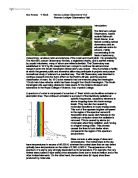
Approximate colors of stars in each
spectral class.
This table tells scientist what gas make up stars and planets by their colours
The grating spectroscope is superior in that it gives a larger spread to the spectrum.
The prism spectroscope concentrates the light within a narrow space, providing a brighter spectrum than the grating spectroscope. It is used for examining the light coming from faint stars and nebulae.
To work out the focal length of a lens you need to know the object distance(U) and the image distance(V) this can be shown in this formula
1/f=1/U+1/V
With an astronomical telescope the object is at infinity and thus 1/U = 0 and a real image is formed at the focal point of the convex lens or concave mirror. This is known as the “prime focus”
The speed of a lens or mirror
This is referred to as the f-number and is a measure of the ability of the lens or mirror to collect light and hence
fNo. = Focal length / aperture
I am going to work out the speed of lens or mirror for the McClean telescope (Refracting) and the Victoria telescope (Reflector) using the information collected at the observatory.
McClean telescope
Focal length = 4000mm
Aperture = 254mm
FNo. = 15.75 (16)
Victoria telescope
Focal length = 1220mm
Aperture = 305mm
FNo. = 4
Photographic exposure time relates to an area and hence is proportional the square of the fNo.
162 / 42 = 256/16=16
The Victoria telescope collects more light and hence the exposure time is1/16th that of the McClean telescope for a similar object.
Magnification
The magnification of a lens is given by the ratio of object to image distances. Astronomical objects are at infinity so this doesn’t work. It is possible to calculate the size of the image at prime focus. Stars are essentially point sources of light but objects like the moon can be measured in terms of the angle subtended at the observer. Both the sun and the moon subtend an angle of 0.5 degrees. The size of the image at prime focus is calculated according to the following formula: -
Image size = focal length X subtended angle (radians)
McClean – Image size = 4000 X .0087 = 35mm
Victoria – Image size = 1219 X .0087 = 10.6mm
In a telescope, the image at prime focus is viewed through an eyepiece, which sends a beam of parallel rays into the eye. Thus the eyepiece is placed at its focal length away from the prime focus. The magnification of the telescope is therefore the ration of the focal lengths of the object glass and the eyepiece.
McClean – 40mm eyepiece. magnification = 4000/40 = 100
Victoria – 40mm eyepiece. Magnification = 1219/ 40 = 30
Placing a supplementary convex lens between the prime focus and the eyepiece can increase magnification. This is called a Barlow lens and lengthens the effective focal length of the object lens. They are usually X2 or X3 denoting the increase in magnification. The alternative is to use a shorter focal length eyepiece.
Sources of information
All pictures on page one-
Top picture on page two –
Bottom picture on page two – I drew myself using paint
Page four - www.twcac.org/Tutorials/spectral_classes.htm