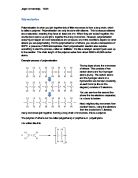
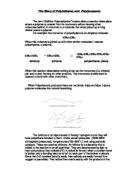
You can see how the second line shows the two electrons separated, i.e. a bond is broken.
Next, neighbouring monomers form covalent bonds, using the electrons from the double bond. Likewise, many monomers join together, forming a long chain of monomers, this is a polymer.
The polymer of ethane can be called poly(ethane) or polythene or polyethylene.
It is written like this:
Uses:
Polymers are used to make plastics, a very popular material, which is one of the reasons why crude oil is in high demand.
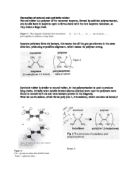
A plastic is formed when multiple chains ( a polymer) are close to each other and are attracted to each other by Van der Waals dispersion forces ( Van der Waals dispersion forces are caused when there is a cluster of electrons on one side of an atom, and this attracts another atom which may have a lack of cluster of electrons on that side so the slightly positive – slightly negative electrostatic attracts the atoms).
In the molecular level, certain chains may lie close to each other, packed together, these parts are called crystalline. Parts where the chains are jumbled, not closely packed are called amorphous.
Many types of polymers are formed with the many alkenes. I will talk about the plastic poly(ethene):
There are two types of poly(ethane)→ Low density polythene (LDPE) and high density polythene (HDPE)
LDPE
-
This has quite a lot of branching chains, thus creating jumbled chains, so it is amorphous
- Amorphous areas means that the chains are inefficiently packed, so there is less of the Van der Waals attraction force (as the chains may be farther away)
- This reduces the strength of the bond between chains, thus lowering the strength of the material and the melting point.
- So LDPE is used for light, flexible and weak material such as plastic bags
HDPE
- Unlike LDPE, the structure of HDPE is 95% or more crystalline
- This means that there are greater Van der Waals forces, so the attraction between the chains is higher
- This means that the material is stronger, higher density and has a higher melting point
- HDPE is used to make stronger things like plastic milk bottles, plastic pipes etc.
Cracking
Cracking is the opposite of polymerisation; it is when large hydrocarbon molecules are broken up into smaller ones (which are more useful). It is a form of thermal decomposition (breaking down of a compound with the action of heat), that requires high pressure and a catalyst.
Usually in crude oil, there is a higher percentage of long-chained hydrocarbons, such as bitumen, than small-chain hydrocarbons such as petrol. However, we need small chained molecules more as thay are more volatile, and so are useful for cookers, combustion in cars etc. In order to get the petrol we need, we crack the large hydrocarbons into smaller ones.
During cracking, there are many different combinations of hydrocarbon molecules that the starting hydrocarbon can be split into, and each reaction gives a random combination.
The process
You take the required crude oil fraction, heat it so it is a gas and pass it over a catalyst (which is silicon dioxide mixed with aluminium oxide) at 500oC
Example:
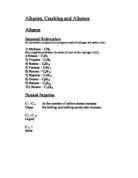
You can see that hexane (C6H14) is being cracked to form ethane (C2H4) and butane (C4H10).
There are two ways of cracking:
Cracking is really useful as it splits to give alkenes, which are used to make plastics (after being polymerised), and short-length hydrocarbons, such as petrol which are essential for everyday life.