

Toby Elliott Periodic table II 09/05/2007
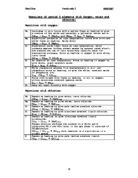
Reactions of period 3 elements with Oxygen, water and chlorine:
Reactions with oxygen:

Reactions with chlorine:
Reactions with “COLD” Water:
Dot and cross diagram of aluminium chloride dimmer Al2Cl6:
Oxide of period 3:
Chlorides of period 3:
The formulas and bonding of the chlorides of period 3 elements are shown in the above table.
The increase in metallic character in group 4:
The chemistry of the elements in Group 4 changes from that of a non-metal it carbon to that of a ...
This is a preview of the whole essay
Reactions with chlorine:
Reactions with “COLD” Water:
Dot and cross diagram of aluminium chloride dimmer Al2Cl6:
Oxide of period 3:
Chlorides of period 3:
The formulas and bonding of the chlorides of period 3 elements are shown in the above table.
The increase in metallic character in group 4:
The chemistry of the elements in Group 4 changes from that of a non-metal it carbon to that of a metal in lead. Metallic character, chemically speaking, involves
• the formation of positive ions
• the formation of predominantly ionic chlorides which do not hydrolyse significantly when placed in water
• the formation of ionic oxides which are basic or amphoteric.
The physical properties of the Group 4 elements change from those of typical non-metals to those of metals. There are exseptions to the rule graphite does conduct eletricity along the parallel layers.
The ionic chlorides dissolve in water to give hydrated ions and neutral solution. The covalent chlorides, though, have bonds which undergo nucleophilic attack by lone pairs of electrons from the water molecule.
Physical properties of group 4 elements:
The melting temperatures, though, are not typically non-metallic for carbon and silicon; instead they are a reflection of the fact that. The density shows a gradation from typically non-metallic low values to the higher density associated with metals. these atorns can form four covalent bonds and therefore are able to produce very large three-dimensional giant molecules.
A.s the size of the atoms in the group increases, the ionisation energies fall. With lead (+2) the first two ionisation energies are sufficiently low to result is PbCl2 being ionic anti not hydrolysed by water. PbO and Pb02 are both amphoteric; PbO2 in addition is strongly oxidising.
Chlorides of group 4:
Oxides of group 4:
the main properties of these oxides are that the trend from non-metal to metal in both groups is shown by increasing basicity and ionic character in the oxides.
Properties of group 4 chlorides:
Ionice compounds are favoured if the ionisation energies of the cation (endothermic) and the electron affinities of the anion (which overall may be exo- or or endothermic) are compensated by the exothermic lattice enthalpy of the resulting compound.
Oxidation states in group 4:
Bond lengths and strengths between group 4 elements:
Chlorine atoms around a carbon are quite bulky, and prevent access of the attacking hydroxide ion to the carbon atom. This is called steric hindrance. The chlorine atoms are so bulky that they repel one another in CCl4 (terachloromethance) and this is the reason why the C-Cl in weaker than the Si-Cl bond in SiCl4