The Effect of Concentration on the Rate of Decomposition of Calcium Carbonate.
The Effect of Concentration on the Rate of Decomposition of Calcium Carbonate.
PLAN
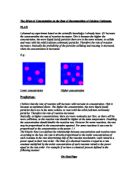
I planned my experiment based on the scientific knowledge I already have: If I increase the concentration the rate of reaction increases. This is because the higher the concentration, the more liquid (acid) particles there are in the same volume, to collide and react with the solid (calcium carbonate) particles. Therefore the rate of reaction increases. Basically the probability of the particles colliding and reacting is increased, when the concentration is increased.
E.g.;
Lower concentration Higher concentration
Prediction:
I believe that the rate of reaction will increase with increase in concentration. This is because as explained above. The higher the concentration, the more liquid (acid) particles there are in the same volume, to react with the solid (calcium carbonate) particles. Therefore the rate of reaction increases.
Basically, at higher concentrations, there are more molecules per litre, so there will be more collisions, so the reaction rate should be higher at the same temperature. Doubling the concentration should double the reaction rate. However for some reactions, the rate may be proportional to the concentration squared. For some reactions it can even be proportional to the concentration to the power 1.5
The Kinetic Rate Law defines the relationship between concentration and reaction rates. According to the law, the rate is directly proportional to the molar concentrations of each reactant in the rate-determining step of the reaction mechanism; each raised to a power equal to their rate order. The Rate of a chemical reaction is equal to a rate constant multiplied by the molar concentration of each reactant raised to the power equal to the rate order. For example if we have a chemical process defined in the following manner:
On Next Page
Continuation
A + B ----> C
According to the Rate Law:
Rate = k [A]m [B]n
where:
k = rate constant
m = rate order in respect to A
n = rate order in respect to B (http://edie.cprost.sfu.ca/~rhlogan)
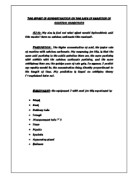
Preliminary Plan
Measurements I chose:
Size of calcium carbonate: Medium
Concentration values of acid: 50:0
40:10
30:20
20:30
Mass of calcium carbonate: 10.00g
Temperature of Hydrochloric acid: Constant
Preliminary Method:
I placed the 10.00 grams of calcium carbonate in to a conical flask (as shown above). I then added the amount of acid and water I had chosen. I quickly replaced the rubber bung on top of the conical flask in order to let out as little gas (co2) given off, out of the flask as not to hinder the accuracy of the results. As soon as I had done this I started the stopwatch. A tube was attached to the rubber bung (as shown above) which allowed the co2 to flow to a gas syringe where I could measure the amount of gas collected. I recorded the volume of gas collected in the gas syringe every ten seconds. I recorded it every ten seconds in order to get an accurate rate of reaction throughout the experiment. During the experiment I kept the Hydrochloric acid and water the same temperature as not to introduce another limiting factor (an increase in temperature increases the rate of reaction). I also used the same amount and surface area of calcium carbonate in order not to introduce another limiting factor which would make the results unreliable (the larger the surface area the quicker the rate of reaction).
Preliminary Results:
Time
Concentration of acid
50.00
40.10
30.20
20.30
0.40
Molar =
0.8
0.6
0.4
0.2
Experiment 1
Experiment 1
Experiment 1
Experiment 1
Experiment 1
0
5
4
3.5
2
20
9
6
5.5
2
2.5
30
4
9.5
0
3
3
40
21
5
4
3.5
3
50
27.5
7
8.5
...
This is a preview of the whole essay
Preliminary Results:
Time
Concentration of acid
50.00
40.10
30.20
20.30
0.40
Molar =
0.8
0.6
0.4
0.2
Experiment 1
Experiment 1
Experiment 1
Experiment 1
Experiment 1
0
5
4
3.5
2
20
9
6
5.5
2
2.5
30
4
9.5
0
3
3
40
21
5
4
3.5
3
50
27.5
7
8.5
4
3.5
60
35
22
23
5
3.5
70
43
28
28
5.5
4
80
52
32
34
6
4
90
61
39
40
7
4.5
00
69
45
45.5
8
4.5
10
80
50
51.5
9
5
20
90
57
57.5
1
5
30
00
63
63
2
5
40
70
69
4
5.5
Final Method
Final measurements I used
Size of calcium carbonate: Large
Concentration values of acid: 50:0
40:10
30:20
20:30
Mass of calcium carbonate: 5.00g
Temperature of Hydrochloric acid: Constant
For the final method I did the experiment as in my preliminary method. The only things I changed were the size and the mass of the calcium carbonate. I changed the size of the calcium carbonate chips because the medium size still had, quite a large surface area so they reacted to quickly for me to get enough results for the experiment to be accurate. I also changed the mass of calcium carbonate, this was also because there were lots of calcium carbonate chips (therefore quite a large surface area) to react with the hydrochloric acid. So the reaction went to quickly for me to be able to get enough results to determine how concentration effects the rate of reaction, accurately.
Time
Concentration of acid
50.00
40.10
Molar =
0.8
Experiment 1
Experiment 2
Experiment 1
Experiment 2
0
4
5
3
3
20
7
8
4.5
4.5
30
1
2
7
9
40
6
8
1
2
50
22
24
4
6
60
29
31
9.5
22
70
38
39
25
29
80
46
47
31
35
90
54
56
36
43
00
63
65
44.5
49.5
10
71
69
51.5
56
20
81
82
59
64
30
88.5
90
65
71
40
95
97.5
67
76
Average after 140 secs=96.25
Average after 140 secs=71.5
Time
30.20
20.30
0.40
Molar =
0.6
0.4
0.2
Experiment 1
Experiment 2
Experiment 1
Experiment 2
Experiment 1
Experiment 2
0
3
2
.5
2
20
4
4
2
2.5
.5
.5
30
7
5.5
2.5
3
.5
.5
40
9
8
3
3.5
2
2
50
2
2
3
4
2
2
60
6
6
3.5
5
2
2
70
20
21
4
5.5
2
2
80
25
27
4
6
2.5
2
90
30
28
4.5
7.5
2.5
2.5
00
35
39
5
8.5
2.5
25.5
10
40
46
5.5
0
2.5
2.5
20
44
51
6
1
2.5
2.5
30
50
58
7
3.5
2.5
2.5
40
55
64
7.5
5.5
3
3
Average after 140 secs=59.5
Average after 140 secs=11.5
Average after 140 secs=2
Conclusion
As I predicted the rate of reaction increased with the increase of concentration of the hydrochloric acid. You can see this from the graphs of all the different concentrations.
For example:
On the graph, of the first set of results, you can see after seventy seconds the gas given off (cm3) agrees with my prediction.
Ratio of concentration of acid (Cm3) Of Gas Given off
50.0 38
40.10 25
30.20 20
20.30 4
0:40 2
On the graph, of the second set of results, you can see after seventy seconds the gas given off (cm3) agrees with my prediction.
Ratio of concentration of acid (Cm3) Of Gas Given off
50.0 39
40.10 29
30.20 21
20.30 5.5
0:40 2
Both set of results shown above, show that the amount of gas given off (cm3) decreased with the decrease in concentration. The amount of gas given off was directly proportional to the concentration.
The reason for this is that, the higher the concentration, the more liquid (acid) particles there are in the same volume, to collide and react with the solid (calcium carbonate) particles. Therefore the rate of reaction increases. Basically the probability of the particles colliding and reacting is increased, when the concentration is increased.
Evaluation
My results were quite accurate, as you can see from my graphs. They show that the rate of reaction is directly proportional the concentration of the hydrochloric acid. As you can see from the graphs I've done on each concentration ratio, showing both experiments. There is quite a difference between the results of each experiment in some cases. Such as concentration 40:10(0.8M). The results are the same for both experiments up until twenty seconds after that they start to vary by about two degrees and eventually by four degrees. This means that I cannot accurately determine the overall rate of reaction for the concentration 40:10. The same happened for the concentration 30:20. After 140 seconds there was a difference of one hundred and forty degrees. This means that for this one also, I cannot accurately determine the overall rate of reaction for the concentration 30:20. Apart from that I only had a few anomalous results. Which I have highlighted on the graphs. One is at seventy seconds, for this I can only suggest human error. The same seems to have happened at ninety seconds at a concentration ratio of 30:20 (o.6M) If my experiments had been totally accurate my graph showing the average amount of gas given off at 140 seconds would be a straight line going diagonally down as shown on the graph.
On the graph showing my first final set of results there are only two anomalies (highlighted on the graph) Were my graph seems to drop at the last reading (140 secs) it should have continued like I've shown with a dashed line on the graph. Also the first two results (first twenty seconds) for the concentration ratios 40:10 and 30:20 where the same whereas with all the other results I would expect a difference of a few degrees.
In my first set of results I believe my results for the concentration ratio 30:20 to be incorrect. As with the ratios 50:0, 40:10 and 30:20 seem to have a small range between each other as does 20:30 and 10:40. But between 20:30 and 30:20 there is quite a difference, which is less apparent in the second set of results.
In my second set of results there are three anomalies where the amount of gas given off does not keep constant. One at 120 seconds at the concentration ratio of 50:0 and one at 90 seconds at a concentration ratio of 30:20. Also at the concentration of 30:20, after20 seconds the result is out by about a degree (it shouldn't join up with another set of concentration results). Also there is quite a difference between the results for the concentration ratio 20:30 and 30:20 whether this is human error I'm not sure, because it has reoccurred twice it may be accurate.
Due to the fact that both graphs for both the experiments, are very similar I believe I can take these results as accurate enough to back up my conclusion.
Ways of improving my experiment
To make my experiment more accurate I could work with somebody, so that when I placed the Hcl and the calcium carbonate together and they are reacting I could replace the rubber bung and they could start the stopwatch. This would prevent the stopwatch being started after gas has already collected in the gas syringe. Therefore preventing inaccuracies. Also I could have got the same mass of calcium carbonate each time. But unfortunately I didn't have hours to get them exactly the same. They were only ever different by up to 0.5 grams. I could have used a new, dry conical flask for each experiment in order to eliminate contamination and make the experiment more accurate.
I could also have made it a tighter seal between the bung and the conical flask to prevent some of the gas given off from leaking.
Further experiments
In this investigation the rate at which aluminum replaces hydrogen from a solution of hydrochloric acid will be observed.
Apparatus
* Test tube,
* Test tube clamp
* Beakers 100 ml, 1000 ml
* Glass right angle bend
* Rubber stoppers
* Rubber tube
* Safety goggles
* Aluminum metal
* Hydrochloric acid, 1.0N HCI
* Stopwatch or clock with second hand
* Bunsen burner
. Add strands of aluminum metal to a test tube. If any strands are longer than 1-1/2", bend them in half.
2. Moisten the hole in the rubber stopper and also one end of the glass right angle bend. Carefully insert the right angle bend into the stopper. Attach the rubber tube to the other end of the glass bend. Set the stopper assembly aside for now.
3. Put on your safety goggles and gloves. Add just enough 1.0N hydrochloric acid, HCI, to the test tube to cover the aluminum metal, not over 1-1/2".
Note: The aluminum metal has an oxide coating on its surface. This coating acts as a barrier between the metal and the acid, and it prevents the reaction from proceeding at its maximum rate.
4. While holding the test tube at a 45 degree angle, gently warm the acid solution, do not boil (a candle could be used as the heat source). The warm acid will gradually remove the oxide coating and the rate of reaction between the aluminum and the acid will increase.
5. Insert the stopper assembly into the test tube. Use the 400-ml beaker to support the test tube as shown below.
6. Fill the 100-ml beaker with water. Place the free end of the rubber tube in the beaker.
7. Observe the rate at which bubbles of hydrogen gas are escaping from the end of the rubber tube.
8. As soon as the rate slows down to the point where it is possible to count each bubble as it rises to the surface, begin taking data. While one person keeps track of time, another counts bubbles released.
Count the number of bubbles released in 30 seconds. Repeat this process, counting the number of bubbles released in 30 second intervals, for a total of at least eight, 30 second time segments, or until the number of bubbles released during a 30 second interval has dropped to about 4. Record all data.
This is another way of finding how concentration affects the rate of reaction. (How as the HCl becomes less concentrated, as its particles continue to react with the aluminum particles, the reaction rate decreases)
Another experiment is...
Method
. Obtain five 250-mL beakers, about 30 ml of hydrochloric acid solution, and about 80 ml of sodium thiosulfate solution.
2. Label the beakers from 1 to 5.
3. Add the amounts of sodium thiosulfate solution and distilled or deionized water to each cup indicated in the following table:
Beaker
Number
Volume of
Sodium Thiosulfate
(ml)
Volume of
distilled or deionized
(ml)
25
0
2
20
5
3
5
0
4
0
5
5
5
20
* Note that the total volume in each beaker is 25 ml.
* Make a table that shows the information in the table above and also includes a column for time (sec) and relative rate (sec-1).
* Make a small "x" on a sheet of white paper with a pencil.
* Place a beaker containing the sodium thiosulfate solution over this "x." Add 5 ml HCl solution and begin timing the reaction as soon as the acid touches the sodium thiosulfate solution.
* Stir the reaction mixture at a constant rate throughout the reaction.
* Stop timing when the "x" under the beaker is no longer visible through the solution.
* Record this time in your data table.
* Repeat steps 2-4 for the remaining samples.
This is another way of finding how concentration affects the rate of reaction. It is generally less accurate than my original experiment. I could extend my investigation further by doing the same experiment as my original one.But changing the calcium carbonate for other substances to find out which substances react directly proportionally to the concentration of the HCl and which are proportional to the concentration squared or to the concentration to the power of 1.5.