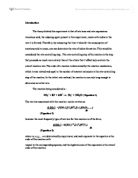
however the most frequently type of rate law for this reaction is of the form;
d [IO3-] =k([IO3-] m,[I-]n,[H+}p,.)
dt (Equation 3)
where m, n, p,… are determined by experiment, and each exponent in the equation is the order of the reaction with
respect to the corresponding species, and the algebraic sum of the exponents is the overall order of the reaction.
The equation for the reaction of arsenious acid and I3- :
H3AsO3 + I3- + H2O→H AsO42- + 3I- +4H+ (Equation 4)
While the equation for the overall reaction, up to the time of the starch end point, can be written as:
IO3- + 3H3AsO3 → I- + 3H AsO42- + 6H+ ( Equation 5)
To compute the initial rate of the reaction in terms of the initial concentration of H3AsO3, use the following equation:
Rate = [H3AsO3]0
t (sec) ( Equation 6)
To compute the values of the exponent m, n, and p the following equations can be used:
m = log (rate1/rate2)
log ([IO3-]1/ {IO3-]2) (Equation 7)
n = log (rate 1/rate 3)
log ( [I-] 1 / [I-] 3) (Equation 8)
p = log (rate 1/rate 4)
log ( [H+] 1/ [H+]4) (Equation 9)
The concentration of H+ ion in the sodium acetate-acetic acid buffer is stated below:
[H+] = K [HAc] x 1
[Ac-] γ2± (Equation 10)
Because these solutions are far from ideal, the activity coefficients can not be assumed to be equal to one. The mean activity coefficient must then be
determined by using the Debye-Huckel theory:
log γ± = -0.509 z2 √I
1 +√I (Equation 11)
Procedure
Before the experiment could be carried out, several solutions were needed to be prepared. A solution of two different buffers was prepared and were labeled buffer A and buffer B. Buffer A contained a solution of 100 mL of .75 M NaAc solution, 100 mL of 0.22 M HAc solution and 20 mL of 0.2 percent soluble starch solution were added to a 500 mL volumetric flask, and diluted to the mark with deionized H2O. Buffer A yielded a H+ concentration of about
1 X 10⁻⁵ M. Buffer B was prepared by pipetting 50 mL of 0.75 M NaAc solution , 100 mL of 0.22 M HAc solution and about 10 mL of 0.2 percent soluble starch solution into a 250 mL volumetric flask which was then diluted to the mark with deionized H2O. Buffer B yielded a H+ concentration of about 2 X 10⁻⁵ M.
Three other solutions , 100 mL of 0.03 M H3AsO3, 200 mL of 0.1 M KIO3, and 500 mL of 0.2 M KI , were also prepared. The first solution (0.03 M H3AsO3) was prepared by weighing out 0.3940 g of NaAsO2, which was then quantitatively transferred into a clean 100 mL volumetric flask. 50 mL of deionized water was added and swirled, after which the flask was then filled to the mark with deionized water. The second solution (0.1 M KIO3) was prepared by weighing out 4.2826 grams of KIO3, quantitatively transferring the solid to a clean 200 mL volumetric flask and diluting to the mark with deionized water. The final solution (0.2 M KI ) was created by weighing out 16.6140 grams of KI , quantitatively transferring the solid to a clean 500 mL volumetric flask , and diluting to the mark with deionized water.
Upon completion of solution preparation, the experimental runs were carried out. There were a total of five reactions to be carried out, each only varying in the amount of reactants and type of buffers added. The volumes to be added to each flask were predetermined by the text as shown in the table below, with the exception of the fifth run which was determined, in part by the instructor and the research group.
Table 1.
The volumes were based upon a final volume of 100 mL. The arsenious acid, KIO3 and its corresponding amount of buffer , were placed into one flask while the KI was placed in a second flask. Both flasks were heated in a 298 K water bath. After heating for 10 minutes , the iodine was added to the reaction flask containing the remaining reactants. The flask was shaken a few times and then placed back into the water bath, allowing the reaction to proceed. Using a stopwatch, which was started the moment all of the iodine was added to the reaction flask, the time necessary for the reaction to complete was measured, and recorded in our notebook. The reaction was assumed to be complete the moment traces of a blue color was present in the reaction flask. Each run was then repeated, for a total of 10 runs to insure accuracy in calculations.