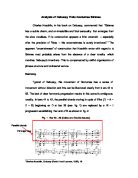
Debussy also uses notes from whole tone scale extensively to further enrich the harmonic colour. A tetrachord of D – E – F# – G#, which has a whole-tone scale relationship between its notes, appears in the melodic line of the mezzos at bar 43 to 44. At the start of bar 44, the music finally arrives to E as a tonal centre which can be implied from the E chord seen in the cello, double bass and 2nd harp part (fig. 4).
Here Debussy decorates the harmony by adding notes from the whole tone scale. In the Oboe and 2nd Harp part, two non-chord tones D and F# are present along with the E major chord tones, which are E, G# and B. The two notes are linked to the tonal centre E by a whole-tone scale relationship. The repeated occurrence of the notes D and F# shows Debussy’s emphasis of whole tone scale here. At bar 44, the whole-tone structure is present in the major ninth chord and prolonged until the end of bar 45. This is shown clearly in the winds section where almost all the instruments are playing a descending whole tone scale as shown in fig. 4. This further illustrates Debussy’s extensive use of whole tone scale in this music.
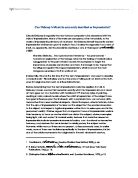
Debussy constantly avoids third of tonic by using seconds, fourths and octaves extensively. As triads are the fundamental building blocks of harmonic music, avoiding thirds or triads weakens the functional harmony and thus produces unclear tonality. From bar 42 to 47, the mezzo sopranos, which are standing out from the rests, has melody lines which are created by sustained use of seconds can be seen in fig. 5. The mezzo sopranos here oscillate between C# and B at bar 42 and rises to F# stepwise at the end of bar 43. From bar 45, mezzo sopranos’ only two notes are G and A. All these are in intervals of seconds so as to avoid a clear tonality by not using thirds.
The strings section also lacks thirds. Instead, they have octaves and seconds as double stops in their parts. The double bass in the whole of bar 42 plays F# octaves and the lower cello part has notes F# and G# played together as a major ninth interval as seen in fig. 6. The fourths exist as intervals both across the string sections and within an instrument part. When the 1st violins’ notes (F#, B, D# and G#) and 2nd violins’ notes (D#, F# and B) are merged to form a chord as fig. 6, one can see that it basically comprises two fourths intervals, namely, F# – B and D# – G#. The higher part of the viola section also plays the notes D# and G# (again a fourth apart). These harmonic configurations last for two bars until the end of bar 43. Therefore, it is shown that these few bars have basically no thirds that gives them a clear functional harmony.
Orchestral texture
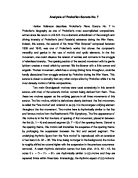
Bars 42 to 55 serve an important and essential purpose of building up to the climax at bar 82 by becoming increasingly dense in orchestral texture. At bar 38 to 39 (see fig. 7), a few bars before bar 42, the strings section accompanying the winds play pizzicato on chords, creating a light texture overall. The two harps also play ascending sweeping notes which lightens the texture further.
However, this starts to change at the beginning of bar 40. The strings section changed to arco instead of pizzicato and the harp stopped playing. This gives a denser texture compared to the previous bars. The harp from bar 42 to 43 plays arpeggiated chords rather than scalic runs at bar 38 to 39. Furthermore, the demisemiquavers of 1st violins, second violins and double bass are staggered with the demisemiquavers of the violas and cellos, producing a unique effect in the accompaniment. All these gradually build up the orchestral texture for the climax. Also, Debussy uses parallel motion to thicken the texture. Examples can be seen at bar 44 to 45 (refer to fig. 8), where the motive played by winds is in parallel motion with the 1st and 2nd violins at bar 44 to 45 falling in thirds in parallel motion.
Most importantly, at bar 48 to 49, the chromatic scale leading up to a change in tonal centre from E to C# is also arranged in parallel motion for the 1st violins and 2nd violins (see fig. 9). This thickens the texture quickly and creates tension to signify a change in the tonal centre.
Phrase structure
In bars 42 to 55, the phrase structures could be interpreted in several ways. Phrases could be standing on its own, comprising an antecedent and a consequent. At the same time, however, it could also be interpreted as an antecedent or consequent which is part of a larger phrase. This kind of symmetrised phrasing allows the repetition of phrase fragments which provides balance and stability and compensates for the unclear harmony cause by and constantly fluctuating tonal centres. The antecedent introduces the material and consequent reemphasises and concludes the newly introduced material. An example would be at bar 42 to 43, where the phrase can be either considered as antecedent to the consequent at bar 44 to 45, or it can be split into an antecedent and consequent within itself. Similarly, this also occurs in bar 46 to 49, which is varied repetition of bar 42 to 45. Even bar 42 to 45 can be interpreted as the antecedent of the whole phrase from bar 42 to 49. The mezzo sopranos’ notes from bar 42 to 45 are echoed later by the sopranos starting at bar 46, singing a sixth higher. As the melodic contour of mezzo sopranos in bar 42 to 45 are similar to that of the sopranos in bar 46 to 49, thus it could be a whole phrase starting from bar 42 and ending at bar 49.
In conclusion, Debussy deliberately drops the functional harmony by avoiding the thirds. He adds value to the timbre and texture in his music by using notes from wholes tone scale and changing the orchestral texture when needed, resulting in the use of the wide range of orchestral textures and harmonic colour.
Word count: 1447
Charles Koechlin, Debussy (Paris: Henri Laurens, 1956), 18