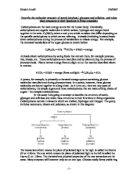
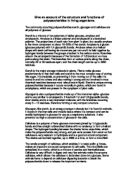
A diagram comparing α and β glucose:
Glucose is a hexose [6-carbon] sugar. Its molecular formula is (CH2O)6 or C6H12O6. the structural formula for glucose is:
Some of the terms used above are explained in the list below:
- Monosaccharide – Constructed of one simple sugar unit
- Disaccharide – Constructed of two simple sugar units
- Polysaccharide – Constructed of multiple simple sugar units
Starch, glycogen and cellulose are all forms of complex carbohydrates that are stored as a source of energy. Starch is the major form of stored energy in plant cells, glycogen is the major form of stored energy in animals and cellulose is a tough substance used for structural purposes in plant cells. All three of these carbohydrates are polymers (naturally occurring or synthetic; consisting of large molecules made up of a linked series of repeated simple monomers) of glucose.
It is used by plants to store energy for later use and works by forming grains with an insoluble outer layer. These grains remain in the cell where it is formed, until the energy is needed. Then it can be broken down into soluble glucose units. Starches are smaller than cellulose units, and can be more readily used for energy. In animals, the equivalent of starches is glycogen, which can be stored in the muscles or in the liver for later use.
Foods such as potatoes, rice, corn and wheat contain starch granules that are important energy sources for humans. The human digestive process breaks down the starches into glucose units with the aid of enzymes, and those glucose molecules can circulate in the blood stream as an energy source. A well known classroom experiment to show the break down of starch by salivary amylase (an enzyme secreted by the salivary glands) involves chewing on a piece of bread for a while, it will begin to taste sweet because the enzymes in saliva are already beginning to break down the starch into glucose, a sugar.
Starches consist of three hundred to one thousand α -glucose units bonded together and is a mixture of two types of chain made from these α -glucose units.
The first type of chain is amylose, which forms roughly 20% of the starch. These chains are made by many α -glucose molecules condensing together to form 1,4 glycosidic bonds, so producing long un-branched chains. As shown in the diagram below, these chains are arranged in a helical/coiled configuration as each monomer has a ‘bulky side group’, which has to be accommodated.
The configuration of amylose:
The second type of chain is amylopectin, which forms the other 80% of the starch (both the percentages for amylose and amylopectin vary from one species to another). These chains are branched and consist of α -glucose condensed in two ways forming 1,4 and 1,6 glycosidic bonds. The coiled chains of amylopectin may contain one thousand five hundred monomers with branches at every ten units.
The configuration of amylopectin:
Glycogen is a starch like polysaccharide, which is found in the liver and muscles of humans and the higher animals and in the cells of the lower animals. It is also found in fungi but not plants. Chemically it is a highly branched condensation polymer of α-glucose; it is readily hydrolyzed to glucose. Glycogen is an insoluble storage product and is formed by the liver from glucose in the bloodstream. It is stored in the liver in small granules. The conversion of glucose to glycogen (glycogenesis) and hydrolysis of glycogen to glucose (glycogenolysis) together are the usual mechanism for maintenance of normal levels of blood sugar. Glycogen is also produced by and stored in muscle cells; during short periods of strenuous activity, energy is released in the muscles by direct conversion of glycogen to lactic acid. During normal activity, energy is released by metabolic oxidation of glucose to lactic acid.
Like amylopectin, glycogen is made up of condensed α-glucose to form 1,4 and 1,6 glycosidic bonds. The chains in glycogen however, are more branched and shorter than those of amylopectin. Each chain may only be ten to twenty units long. There are no un-branched chains in glycogen.
Cellulose is the principle structure of a plants cell wall. It has very different properties from starch or glycogen. It is composed of chains of roughly one thousand five hundred β-glucose monomers and are condensed to form 1,4 glycosidic bonds. Adjacent cellulose chains interact and rotate through 1800 to form hydrogen bonds. These hydrogen bonds are formed between the –OH groups and the oxygen of adjacent straight chains. These parallel cellulose chains form “ribbons” by bundling up called microfibrils. These microfibrils have a strong fibrous structure and they cluster to form macrofibrils. The macrofibrils have immense tensile strength and stability and are arranged in a gel like matrix of other smaller polysaccharides in plant cell walls.
Even though human digestion cannot break down cellulose for use as a food, animals such as cattle and termites rely on the energy content of cellulose. They have protozoa and bacteria with the necessary enzymes in their digestive systems. Cellulose in the human diet is needed for fibre. Another example of cellulose in nature is the fact that wood consists of mostly cellulose. This makes cellulose the most abundant type of organic compound on the Earth.
The diagram below shows the condensation of two β-glucose monomers forming a portion of a cellulose molecule:
Starch and cellulose are very similar in structure but only starches can be used as energy sources by the human body while cellulose cannot. Enzymes are important in the metabolism of foods, and these enzymes are very specific. They are somewhat like keys which will fit the geometry of the starch bonds, but not those of the cellulose bonds. An image showing the slight yet important difference between the formation of a starch molecule and the formation of a cellulose molecule is shown below:
References:
- Collins Advanced Modular Sciences Biology As (Second Edition) by Mike Bailey and Kieth Hirst
- Advanced Biology Principles and Applications (Second Edition) by C J Glegg with D G Mackean
- As Level Biology by Phil Bradfield, John Dodds, Judy Dodds and Norma Taylor
- As (AQA BIOLOGY Specification A) A New Introduction to Biology by Bill Indge, Martin Rowland and Margaret Baker
- http://www.indstate.edu/thcme/mwking/carbohydrates.html
- http://hyperphysics.phy-astr.gsu.edu/hbase/organic/carb.html#c3
- http://users.rcn.com/jkimball.ma.ultranet/BiologyPages/C/Carbohydrates.html
- http://www.biochem.purdue.edu/
- http://www.fibersource.com/f-tutor/cellulose.htm