

Discuss the biology of muscular dystrophy
One of the most baffling diseases is muscular dystrophy. Muscular dystrophy (MD) is a group of genetic disease that causes weakness and progressive degeneration of skeletal muscles. There are 9 major forms of MD – Duchenne, Becker, myotonic, limb-girdle, facioscapulohumeral, oculopharyngeal, Emery-Dreifuss, distal and congenital(Parker 2002). This essay will focus on the causes and pathological effects of Duchenne muscular dystrophy (DMD) and Becker muscular dystrophy (BMD) which are the most prevalent form of muscular dystrophy.
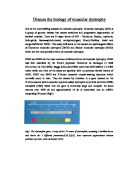
DMD and BMD are the most common childhood forms of muscular dystrophy. DMD was first described by the French physician Duchenne de Boulogne in 1868 (Hendriksen & Vles 2006). Beggs & Kunkel (1990) noted that DMD affects 1 in 3500 males while one third of the cases are sporadic with no previous family history of DMD. DMD and BMD are X-linked recessive muscle-wasting disorders which normally occur in man. They are caused by mutation in a gene located on the X-chromosome which codes for a protein called dystrophin (Cyrulnik & Hinton 2008). Campbell (1995) stated that the gene is extremely large and complex. Its locus extends over 2400 kb and approximately 14 kb is transcribed into an mRNA comprising 79 exons (Fig1).
Fig1. The dystrophin gene. A map of the 79 exons of dystrophin, spanning 2.4million bases and shows the 5 different promoters(C,M,P,S,G). Bars represent approximate relative positions of exons. (Ahn & Kunkel 1993)
The Causes of DMD and BMD
Almost 70% of cases of DMD, and more than 80% of cases of BMD are caused by gene deletion (Brown & Dickson 1994). Even though deletions can occur almost anywhere within the dystrophin gene, they are more likely to be found either around exons 45-55 (1200 kb from the 5’ end of the gene) or close to the first 20 exons (500 kb from the 5’ end) (Brown & Dickson 1994; Ahn & Kunkel 1993) . The site of deletion does not show whether it will cause BMD or DMD. Ahn & Kunkel(1993) suggested that BMD sometimes had a deletion of genes more than DMD. The determination of BMD and DMD is by analyzing the ways of deletions. Frameshift deletions will cause a totally functional inactivity of protein and result in DMD while in-frame deletions will cause a partially inactivity of protein and result in BMD (Beggs & Kunkel 1990).
The role of dystrophin
Petrof , Shrager , Stedman , Kelly & Sweeney (1993) pointed that the dystrophin is normally found on the cytoplasmic surface of skeletal muscle cell membranes .It mainly serves a mechanical role in muscles cells by linking the cortical actin cytoskeleton to the extracellular matrix(Winder 2006). The loss of linkage between the actin cytoskeleton and the extracellular matrix render the muscle fibres vulnerable to mechanical damage during activity (Ahn & Kunkel 1993). Fig 2 shows the dystrophin protein in muscular dystrophy patients.
Figure 2. Analysis of dystrophin by western blotting. Normal-sized dystrophin is indicated; samples in lanes 2, 4, and 6 contain absent or abnormal dystrophin.
So, lane 2 represents a patient with DMD; lane 4 represents BMD; and lane 6 represents severe BMD (low abundance of dystrophin). Patterns in lanes 1, 3, 5, and 7 are from normal controls .Comparison with levels of myosin (below) allows normalization for amounts of total muscle protein loaded. (Beggs & Kunkel 1990)
The Pathology of DMD and BMD