

Both Chinua Achebe and Tatamkhulu Afrika explore the dark side of human nature in the poems: "Vultures" and "Nothings Changed" By closely referring to the language and structure of both poems, compare the way the poets present their concerns
Both Chinua Achebe and Tatamkhulu Afrika explore the dark side of human nature in the poems: "Vultures" and "Nothings Changed" By closely referring to the language and structure of both poems, compare the way the poets present their concerns Both of the poets are trying to explain the evil that can go on in people's minds and how race and colour can make huge differences in the way that people can be perceived. They do this in very different ways and as both of the poets had very different backgrounds, they bring their own experiences into the poems. Whilst Afrika is an Egyptian and as such was of mixed race, he was raised as a white man so that he would not suffer some of the racial abuse that exists in Egypt. Chinua Achebe on the other hand is a black-African and was not that badly treated. He was born in 1931 and was very well educated. He was kept away from the racial abuse and in his poem he has tried to make the reader decide on what was happening. He has not told the reader what to think, unlike Afrika, he has let the reader judge for himself. In the first four lines of Afrikas' 'Nothing's Changed' the poet has tried to make sure that you feel relaxed, using calming words and images such as 'Seeding grasses' and 'Round hard stones click'. Those words bring about a mental image of a meadow, calm with nothing wrong anywhere. It uses repetition of 's' sounds and gives

What does the poem 'Nothing's Changed'
Cara O'Toole 11P English Coursework. 20/09/2004 What does the poem 'Nothing's Changed' Have to say about identity? How does Tatamkhulu Afrika convey his ideas? This is an autobiographical poem The word 'identity' the characteristics that make you who you are, everyone is an individual and unique, this is expressed through peoples culture and tradition, Culture is a way of expressing your identity, for example what music you like to listen to and what you enjoy, tradition is used to reinforce your sense of identity. Afrika was adopted at an early age, he grew up not knowing his biological parents.Afrika grew up in a white home, growing up as a white South African, meaning he got treated better, as Apartheid was in place and the law at that time, but as he grew up, Afrika learnt that his father was a black man, meaning he would have been discriminated against, had he grown up with his biological parents. Afrika wanted to pay tribute to his heritage , his early background, culture and tradition by pretending that he is a fully white blooded person. Afrika is proud of his black origins and has changed his name to show that he is partly black. Afrika often describes throughout the poem how disgusted he feels about the way black and mixed race people are treated. The poem opens with monosyllabic words;"small, round, hard stones click" this shows how he is
Did Saltaire change for the better?
Did Saltaire change for the better? Introduction Saltaire before Titus salt was just a small village. It was just a little settlement a little outside of Bradford. This was the total opposite of Salts dream and the current conditions of Bradford. He wanted to change Saltaire into a model village for his Salts mill and improve the working conditions from their current state. He decided to build the mill because of recent investment. He came across some alpaca wool. To anyone else this was useless because you couldn't weave it right. He got a few engineers to help him come up with a way to improve it. He found out how to mix it and then weave it into fine cloth. This became very expensive and the queen even purchased some. He now began construction of his gigantic mill in 1850. He then found that people had to come form Bradford to work here so he decided to build his own housing. This consisted of 850 houses, 22 streets and 45 almshouses. To provide 45 almshouses was excellent, other villages would have 4 or 5 houses tops, 45 was a lot better. This shows how generous and serious about building his village. He then went on to construct a hospital and a tram shed. The Hospital + Hygiene The hospital was built to give workers and their families medical care, a healthy workforce was an efficient workforce. It started off as two storeys but had a third in 1908, and another

Nothings Changed - Describe the irony of the title of Tatamkhulu Afrika's poem
Nothings Changed Describe the irony of the title of Tatamkhulu Afrika's poem Nothing's Changed. In this coursework, I am going to write about the irony of the title of Tatamkhulu Afrika's poem Nothing's Changed. I am going to achieve this by going through the poem and picking out important points, like how his familiarity of the place hasn't changed etc, and explain these points and relate them to being ironic to the title. We assume that the poet has been away from this place for a long time at the beginning of the poem. The poet then informs us that the place was District Six. Even though no board said it was District Six, he recognizes the place. This could be because District Six was like a part oh him. Therefore we can see that even though the place may have changed physically, his familiarity of the place has not changed. "no board says it is by my feet know and my hands..." As we move on in lines 15 and 16 we get the first impressions of the poet's emotions. The lines are very bitter and show his hatred and anger towards the whites. He is furious for some reason and is about to explode as anger is building up inside him. Even though Apartheid has ended, hatred against the whites has not changed. "and hot, white, inwards turning anger of my eyes" In the next stanza the poet talks about a new, posh cuisine. He tells us that a guard stands at the gatepost and
Write about at least 2 poems in which the author focuses on identity - "Nothings Changed" and "Search for my tongue".
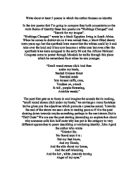
Write about at least 2 poems in which the author focuses on identity In the tow poems that I'm going to compare they both concentrate on the main theme of identity these two poems are "Nothings Changed" and "Search for my tongue". "Nothings Changed " wrote by a black Egyptian living in South Africa. When he comes to district six as it was named then, a black filled shanty town years ago but the apartheid laws meant that the whites could by it and take over the land and it has now become a white area but even after the apartheid laws were scrapped in the early 90 and the African National Congress came to power through Mandela he walks through this place which he remembers from when he was younger. "Small round stones click And then under my heels, Seeded Grasses thrust Bearded seeds Into trouser cuffs, cans, Trodden on, crunch In tall , purple-flowering, Amiable weeds." The poet first gets us to focus in and imagine the sounds that is making, "small round stones click under my heels," we envisage a mans footsteps but he gives you the adjectives which promote a prescise sound. Towards the end of the stanza we see a slow in reading pace as if it is the poet slowing down towards maybe something perhaps in the next stanza.But in "Half Caste" We can see the poet starting demanding an explanation about why someone calls him half caste why hes put in the category

'Nothings Changed' and 'Ogun are examples of hymns of protest - Examine the ways in which the poet's views and anger are expressed through the poems.
'Nothings Changed' and 'Ogun are examples of hymns of protest. Examine the ways in which the poet's views and anger are expressed through the poems. 'Nothing's Changed' and 'Ogun' are very good examples of hymns of protest. A hymn of protest is a poem that raises awareness about an unjust issue or suffering in the world. The main reason why these poems were written was to show suffering, inequality, racism and slavery in the world. Therefore their aim is to raise the awareness of the reader and motivate them into action. Tatamkhulu Afrika wrote his poem, 'Nothing's Changed' as a result his of personal experience of living in Cape Town, South Africa. He shows separation between the blacks and whites by describing he appearances of a working man's café and a restaurant. As a child he lived in District Six and it was destroyed by the whites for construction in 1966 as a result of the apartheid. As a result 55,000 black Muslims were made homeless and had to struggle to survive. Building work has not been completed, even today and Afrika is very angry with that all those people were made homeless, just because they were different. Tatamkhulu Afrika was an Egyptian-born, child of an Arab father and a Turkish mother. He was raised as a white South African, but later in life chose to be classified as 'coloured' to show his African identity. His poem also reflects on his identity
The two poems I have chosen which convey feelings of alienation and frustration that growing up in a hostile environment such as that of today's society are: "The Places Fault" by Philip Hobsbaum and "Nothings Changed" by Tatamkhula Afrika.
The two poems I have chosen which convey feelings of alienation and frustration that growing up in a hostile environment such as that of today's society are: "The Places Fault" by Philip Hobsbaum and "Nothings Changed" by Tatamkhula Afrika. The Places Fault: This is an autobiographical poem recounting a short unhappy period of the poet's childhood. He was evacuated to North Yorkshire during the war years. While he was little there, he experienced severe bullying, both on the streets and in school and the suffering and taunts and beatings he endured at the hands of the bullies scarred him mentally for the rest of his life. The Hobsbaum's were Jewish and the poet doesn't specify if the bullying was anti-Semitic, but he does blame the bulling on the harsh environment and the tough conditions that youngsters grew up in which he believed turned them into bullies who didn't trust people who looked or acted differently from them such as Philip. There are five verses each six lines long. There is an irregular rhyming pattern, but in general lines 1 and 6 rhyme, 2 and 5 rhyme and 3 and 4 ryhme. In verse one the poet describes being physically bullied at school by teachers who picked on and caned him because his work was untidy. When he left the school, he was physically and verbally bullied by other children, presumably because he was overweight and Jewish. " A stone hissed past
Compare 'Nothing's Changed to 'Two Scavengers in a Truck, Two Beautiful People in a Mercedes', showing how the poets reveal their ideas and feelings about the cultures and traditions that they are writing about.
Compare 'Nothing's Changed to 'Two Scavengers in a Truck, Two Beautiful People in a Mercedes', showing how the poets reveal their ideas and feelings about the cultures and traditions that they are writing about. The poem 'Two Scavengers in a Truck, Two Beautiful People in a Mercedes' has been chosen to be compared to 'Nothing's Changed'. The two poets Tatamkhulu Afrika and Lawrence Ferlinghetti reveal their ideas and feelings about the cultures and traditions that they have talked about through the tone, language and the structure of the poem. The reader can notice that both poets reveal that in an angry way. The poem that Lawrence Ferlinghetti wrote tells us how the poor people feel about the rich when they see them living and staying in a better place than they are. The poem also tells us the separations between the rich and poor. The poem 'Nothing's Changed' talks about the separation between the whites and the blacks and how the whites usually treat the black people. The tone in 'Nothing's Changed' is very angry and violent, to show the poets attitude to the fact that nothing has changed. His ideas and violent feelings are revealed in his tone. He shows a very bad attitude towards white people. The tone can be seen as that of a resigned way, as if he knows that it almost too much to hope that things can change. The poem 'Two Scavengers ...' can be seen as a loud
In what ways were the lives of Africans changed by the policy of Apartheid in the 1950s, 1960s and 1970s?
South Africa Question 3 In what ways were the lives of Africans changed by the policy of Apartheid in the 1950s, 1960s and 1970s? The ways black South Africans lives were changed by Apartheid was by laws of Apartheid. The Bantu Education Act. The Bantustans and the massacre of Sharpeville changed lives of Africans. There were many laws of "Apartheid". The 1950 "Population Registration Act" aim to divide each race, keep separate so they had to register as white, black and coloured. This effect blacks because now they were officially lower class. The 1949 "Prohibition of Mixed Marriage Act" aim was to ban marriages between whites and non-whites. The 1950 "Groups Areas Act" aim was to divide the races into different areas. This was to keep whites and non-whites separate. This also meant some blacks had to more houses, because most of the land was reserved for whites. The 1912 Native (Abolition of Passes and Coordination of Documents) Act aim was to get rid off passes but instead more passes for non-whites. The 1952 "Native laws Amendment Act" aim was to restricting blacks movement in whites areas. Pass laws were needed to know which race they were. The pass laws meant that people could only live in their own racial area. Black men had to carry a pass if 16 or over. If blacks were found without a pass or wrong area was put into prison and lost their job. There was many minor
Nothing's Change
How does Nothing's Changed covey the poets feeling's and attitudes Nothing's changed is an autobiographical poem written by Tatamkhulu Afrika; a white South African who grew up in Cape Town's Disrict Six. The apartheid government declared District Six as an area for only white people, and soon after, the area was destroyed. In this poem he returns to District Six to find the black people in the same situation as before, and though apartheid is said to have been abolished they are still discriminated against. He states that in fact, nothing has changed. When the poet first arrives to District Six in stanza one, he describes the wasteland and overgrown area surrounding him. The first line consists of a sentence with monosyllabic words and each word is therefore stressed; "small round hard stones click". They are also onomatopoeic words and this adds more effect to the opening sentence of the poem. We are informed that there are cans scattered about amidst "tall, purple-flowering, amiable weeds". The "trodden on" cans is possibly a metaphor suggesting that the cans are like the black people being trodden on by white people. Overall the area described seems to be unkempt and neglected; people simply do not care for it anymore as the whites do not care about the black people. Afrika see's a "new, up-market" restaurant which is "brash with glass". These two words produce harsh