


"In their poems "Snake" and "Medallion", D.H. Lawrence and Sylvia Plath describe the snakes in detail. What thoughts and feelings do the poets communicate to you by the images they use?"
Coursework on Animal poems "In their poems "Snake" and "Medallion", D.H. Lawrence and Sylvia Plath describe the snakes in detail. What thoughts and feelings dot he poets communicate to you by the images they use?" In their poems "Snake" and "Medallion", D.H. Lawrence and Sylvia Plath describe the snakes in detail. The poets communicate many thoughts and feelings to the reader by using detailed descriptions of the snakes shown through the layout of the poem, the images and the diction used by each poet. The poem "Snake" is based on D.H. Lawrence's encounter with an innocent snake which came to drink at his own personal water trough. The snake fascinated Lawrence, however due to his ignorance the snake is forced to leave the water trough. The poet's emotions and thoughts before deciding to attack the snake by throwing a log to force it to leave and the poet's guilt are shown to the reader through many aspects. One aspect is the layout of the poem. Lawrence makes the poem seventeen stanzas long in order to give the reader his impressions of the snake. This is because the number of stanzas creates an image of the snake being very long and the detailed content of the poem again shows that the size of the snake. The stanzas are of different lengths and are of free verse. Again Lawrence communicates his feelings to the reader through the layout of the poem suggesting that the

A comparison between 2 poems “Lore” written by R.S Thomas and “Woman Work” by Maya Angelou.
A Comparison between 2 poems "Lore" written by R.S Thomas and "Woman Work" by Maya Angelou Introduction In this assignment I will be studying in detail the 2 poems "Lore" written by R.S Thomas, and "Woman Work" by Maya Angelou. Maya Angelou is a remarkable woman who is well known as one of the greatest voices of contemporary literature. She is an eminent poet, educator, historian, best selling author, actress, and civil rights. The list goes on endlessly. Although not as proficient as Angelou, the welsh poet R.S Thomas is still famous for his 20 volumes of poetry, a career that has expanded for 50 years. He spent his life working as a clergyman in rural Wales. One of his poems was even quoted on the pop phenomenon "Manic Street Preachers" album. The title of the poem "Lore" suggests that this poem is about traditional culture. Verse 1 describes Job Davies life, despite all the hard work; he is still cheerful this is because he is an optimistic and independent being who follows his traditional cultural ways of life. For example instead of using modern technology to meow the lawn he uses the "scythe". In the poem it also suggests that he is against modern technology as it says, "Never mind the machine, whose fuel is human soul" The weather is portrayed as an enemy, as the metaphor "slow poison" is used, it then goes on describing the old and treachery winter, as it
Escape From Alcatraz
Escape From Alcatraz I took in a deep breath, though the air was so filthy, dirty and stale that it just made me choke. "Come on," I said to myself in an assuring tone. "This is for Samantha. All I need to do is climb up the wall and pull away the air vent on the ceiling." The rest of me was screaming wildly, telling me that I would have to pay the consequences if I even thought about escaping from this desolate yet disturbing prison. I took a small step back, as I was so cramped in the tiny cell that it was hardly possible to move. With a quick jerk of my body, I kicked my feet up against the wall so that my body wasn't touching the floor. My head and shoulders were on the other side of the wall, and very slowly, I walked up the cold stone wall. My back was rigid, yet it felt like it was going to collapse under the weight of my body. After what felt like hours of pressure, I finally reached the top of the cell. In the pitch black dark, I could hardly see anything. I reached up, and felt icy cold bars running across. Managing to squeeze two of my fingers between, I forcefully pulled it away leaving a small, square hole in the ceiling. Step by step, I finally succeeded in getting my body through the gap. Placing the metal bars back in place, I hurriedly scampered along a long, thin tunnel. It was hot, damp and smelt of decaying flesh. I must have been walking
The aim of the financial report is to supply information on the costs and revenue of the school production to the school governors. The finance office had some data on the income and expenditure of the school production.
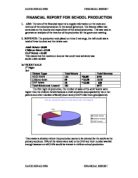
FINANCIAL REPORT FOR SCHOOL PRODUCTION . AIM: The aim of the financial report is to supply information on the costs and revenue of the school production to the school governors. The finance office had some data on the income and expenditure of the school production. This was used to generate an analysis of the revenue of the production for the governors meeting. 2. REVENUE: The production took placed on three 3 evenings, the hall could seat a total of three hundred and the tickets cost: Adult tickets= £6.00 Children ticket = £2.50 OAP tickets = £3.00 This means that the maximum income that could have achieved was £6.00 x 300 =£1800 2a TICKET SALE st Night 2a i Tickets Types Total tickets Total Revenue Adult tickets 32 *£6.00 £792 Children ticket 50 * £2.50 £125 OAP tickets 20 * £3.00 £60 Total tickets and Amount 202 £977 The first night of production, the number of sales of the adult tickets were higher than the children tickets because a child would be accompanied by his or her parents and other member of family (such as any OAP's like there grandparents). This creates a situation where the production seems to be directed for the adults as the primary audience. 10% of the tickets were sold to the OAP and their number was fair enough because not all OAPs would be interest in children school
Write a study of the opening of DH Lawrence's short story
Write a study of the opening of DH Lawrence's short story "Odour of Chrysanthemums". Comment in detail on the way in which Lawrence's use of language creates a particular atmosphere and raises certain expectations In the opening of the short story, "Odour of Chrysanthemums", DH Lawrence talks about how industry is dominating nature. He tells us how mankind cannot stand in industry's way and that it is like a monster we created, which we cannot defeat. The mood Lawrence tries to create in the opening is gloomy and lifeless which suggests that the story will be sad and tragic. The words he uses to achieve this are mostly negative. The title is rather unusual. Lawrence does not use words that are usually associated with the smell of flowers, like "fragrance" or "scented". Instead, he chooses the word "odour" to indicate the smell of chrysanthemums. This suggests that they are starting to wilt because they tend to give off an unpleasant smell when they decompose. From these words, we have a sense that something is wrong and that it might be unpleasant or unhappy. It also suggests that the story might be related to death. The opening of the story starts by depicting the engine. It describes it with negative words like "clanking, stumbling" which is associated to noisiness and clumsiness, to make it sound dangerous and ugly. It is not accomplishing the promise to
In these stories D. H. Lawrence shows animosity between men and women, particularly with husbands and wives. We can also see that this often has roots in class differences.
In these stories D. H. Lawrence shows animosity between men and women, particularly with husbands and wives. We can also see that this often has roots in class differences. These stories are set between the late 1890's and the early 1900's. They are set in industrial towns. The people live in hardship and struggle to make ends meet. The towns are described as dull, dirty, dusty, bleak and lifeless. Fanny and Annie, "The pulse and darkness of red fire from the furnace towers in the sky." The settings are based around the male characters in the stories because it is described as their place of work and affects them in all aspects of their lives. The men are described as tall, handsome and big built characters. Odour of Chrysanthemums, "Man of handsome body... fine limbs" Fanny and Annie, "Fair-haired fellow of thirty-two, with a fair moustache." Whenever the men are introduced into the story there was always a sense of alcohol in the background. The men have animalistic properties. They are rarely described as emotional beings except for Hadrian and the father in You Touched Me. The men are sometimes hinted as being violent. Fannie and Annie, "A man who was no companion to her, a violent man." There is a strong link between the men's place of work and their personality. They get their animalistic properties from their place of work, ironmongers and coal miners need
Original Writing - A jagged scream violently slashed through the silent fabric of the savannah dark.
Original Writing Coursework A jagged scream violently slashed through the silent fabric of the savannah dark. David shot up out of his sleeping bag; only to have his eardrums ricocheted back and forth off an imaginary barrier as the same high-pitched sound hit them for a second time. Rubbing the sleep from his emerald-green eyes, David forced himself up, wondering what on earth it was now that so desperately needed his attention from Brianna. 'A split end probably' he chuckled to himself. He often wondered what on earth a person like Brianna was doing on a zoology course, and the fact that she even opted to go on this field exercise in the middle of the African tropics astonished him. David felt that she was far better suited to hairdressing, in contrast to becoming a wildlife connoisseur. Kicking aside the unsanitary sack of grime and grit that had pretty much become his home over the past fortnight - his sleeping bag - David attempted to locate the luxury of the tent in which Brianna now lay, by only the light of the stars and the smouldering remains of the previous nights fire, which were still erratically flickering. The tent was 15 metres or so away from where David stood, and he groggily advanced to it, in some small part hoping that something had happened to Brianna so that at least he could be rid of her for the rest of this safari. Amidst his lethargic thoughts,
Biography of D. H Lawrence
Biography of D. H Lawrence David Herbert Richards Lawrence was born on September 11 1885 in Nottingham. Lawrence suffered from bronchitis when he was a few days old. He won a scholarship to Nottingham High School. Three days after his thirteenth birthday Lawrence went to the High School. He worked hard and made the best of this opportunity. School was a hard on his health and the family. At fifteen Lawrence began work at Haywoods, a surgical appliance manufacturer in Nottingham. Lawrence's health was not good and work at the factory did not help so he joined the local British School as a pupil-teacher. He also then began to write. In December 1904 Lawrence sat the examination for the King's Scholarship, which would guarantee him a day place at Nottingham University College. He passed but was unable to take up the place until September 1906 because of his money problems. In his free time Lawrence wrote. In December 1910 his mother died from cancer. In January 1911 his first novel(The White Peacock) was published. In February 1912 he published The Trespasser and had published pieces of poetry, essays and short stories. In May 1913 Sons and Lovers was published. It did not sell very well and Lawrence faced the possibility that he may have to return to teaching. He produced a few short stories, articles, essays and pieces poetry that allowed him to live very
D.H. Lawrence's "The Odour of Chrysanthemums" - review
D.H. Lawrence's "The Odour of Chrysanthemums" Commentary by Karen Bernardo Impressionistic and symbolic, dense with figurative language, D.H. Lawrence's "The Odour of Chrysanthemums" relies heavily on imagery (such as the chrysanthemums, and the frequent altercation of darkness and light) for effect. It concerns one night in the life of Elizabeth Bates, mother of two children, pregnant with her third. Her life is hard because she has been disappointed in her marriage; her husband, Walter, although a handsome and strapping man, drinks away most of the wages he receives from his job in the coal mines, and she is too caught up in her own bitterness against him to be able to receive much joy from life. On this fateful night, Elizabeth has absent-mindedly tucked a chrysanthemum into the waistband of her apron, and there are more, fresh-cut, decorating the parlor, but they do not symbolize happiness for her. As she notes, "It was chrysanthemums when I married him, and chrysanthemums when [my daughter was] born, and chrysanthemums the first time they ever brought him home drunk, he'd got brown chrysanthemums in his buttonhole." And it's chrysanthemums again that evening when he is brought in from the mine, dead, and laid out in the parlor. One of the men bringing in her husband's body accidentally knocks over the vase of chrysanthemums she had put there earlier in the evening
Compare the behaviour of the men and women in the two stories, one written before and one after the 1900. Explore what you discover and how you learn of the writer’s viewpoints.
Compare the behaviour of the men and women in the two stories, one written before and one after the 1900. Explore what you discover and how you learn of the writer's viewpoints. In this essay I will be comparing two stories one set before the 1900 and one after. The stories are "Tony Kytes", set around 1870, and "Tickets Please", set around 1918. "Tickets Please" was set after the war, in a world where women were more independent and stood up for any rights they had, working in the men's environments sometimes made them to become more like men as well. Before the war, women never did any work except for in the houses and lived a traditional lifestyle with traditional attitudes. They were supposed to respect their men and make him a good wife and they seem to accept this- "I would make you a finer wife" said one as she tried to get Tony to marry her. This was not true all the time, because some had worked in lower class sectors. "Tony Kytes is similar to "Tickets Please", they are both about men who charm and cheat on women and basically play around with them. Although "Tony Kytes" is not as serious as "Tickets Please". It is about Tony a man who is about to get married to a girl named Milly, but his ex-girlfriend comes back and she in a way seduces him and gets him to try and marry her. He wants to get married to his ex-girlfriend, who had come back, but she